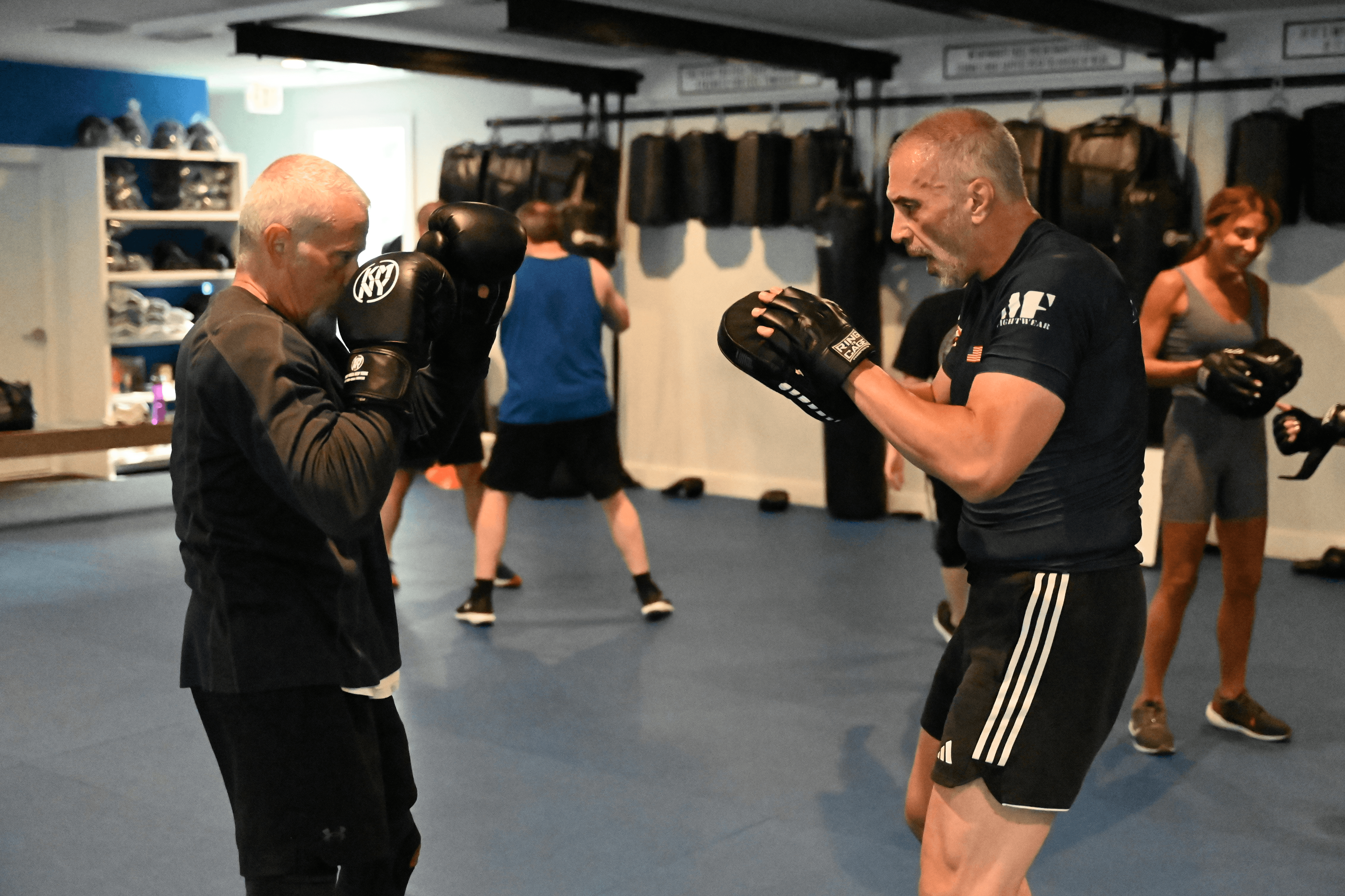
Boxing is one of the most effective striking arts in the world. Real power, real timing, real conditioning. For self-defense though, it's built around a ruleset that leaves some gaps — and knowing where those gaps are changes everything.
You're Not Wrong for Wanting Boxing
Boxing is the obvious choice. It's everywhere — gyms on every block, YouTube tutorials, former champions turned coaches. It can be great for self-defense because it produces fighters you watch on TV. Fast hands, real power, head movement that makes punches miss.
That instinct isn't wrong. Boxing develops genuine striking skill. If you train it seriously, you'll hit harder and move better than almost anyone who hasn't trained anything. That's real.
But there's a gap between "this produces real fighters" and "this prepares me for what actually happens." Boxing closes one and leaves the other open.
What Boxing Was Built For
Boxing is a sport. That's not a criticism — it's a design fact. The rules exist to make competition fair and safe, and those rules shape everything about how the art trains you.
In a boxing match, both fighters are the same size class, gloved, standing, and throwing only punches above the waist. No clinch work beyond a quick tie-up. No takedowns. No ground. No kicks. No weapons.
Train boxing for a year and you'll be dangerous within those rules. Your jab will be sharp. Your defense will tighten. You'll know how to slip a punch and counter it.
The street doesn't run those rules. Nobody checks weight classes in a parking lot. Nobody gives you gloves. The person who grabs you from behind wasn't waiting for you to get into your fighting stance.
The Gaps That Show Up on the Street
Boxing trains one range: punching distance, standing, with gloves on. That's it. Everything the sport removes to make competition safe is also something that happens in real situations.
No clinch defense. In boxing, a clinch gets broken up immediately. On the street, most violence happens in close — grabbing range, not punching range. Boxing doesn't train you there.
No ground. If someone takes you down or you trip, boxing gives you nothing. You're not trained for it because it doesn't exist in the sport.
No kicks. A knee to the thigh or a low kick can change a fight immediately. Boxing doesn't include them, so boxing doesn't train you to use or defend them.
Gloves change your hands. A year of boxing builds muscle memory for hitting with padded fists. Bare knuckle is different mechanics, different targeting, different risk to your hands. That gap is real.
None of this makes boxing useless. It simply highlights a distinct reality about everyday, dynamic self-defense scenarios.
What Krav Maga Trains Instead
Krav Maga starts with the scenario, not the technique. What happens when someone grabs you from behind? What do you do when a threat is two feet away and closing? What's the answer when you're on the ground?
The striking foundation pulls from boxing, kickboxing and Muay Thai — real punches, elbows, knees. But the training doesn't stop at punching range. It covers the clinch, the ground, the grab, and the weapon threat. All of it runs under stress from early on, because that's when your body needs to know what to do.
You're not learning a sport. You're building a response. That's a different thing to train, and it produces different results on a different timeline.
Most people who walk in with no experience are functional in weeks, not years. Not because Krav Maga is easier — because it's built for exactly this goal.
Speed of Development
Boxing takes years to become functional. Not because it's poorly designed — because the skill ceiling is high and the sport demands that you build it properly. A year in and you're still a beginner by competitive standards.
Krav Maga is built around a different question: how fast can someone with no background learn to respond correctly under pressure? The answer is weeks, not years. The curriculum strips out anything that doesn't transfer directly. What's left is fast to acquire and built to hold up when your heart rate spikes.
If you have five years and want to compete, boxing is a legitimate path. If you want to know what to do the next time something unexpected happens, Krav Maga gets you there faster.
Should You Train Both?
Yes of course. Boxing will never "not be worth learning". Boxing and Krav Maga can complement each other. Better striking mechanics from boxing, sharper real-world responses from Krav Maga.
But sequence matters if you're starting from zero. Krav Maga first gives you the framework — multiple ranges, ground defense, the situational responses. Boxing then sharpens the striking on top of that foundation. The other order works too, but it takes longer to close the gaps.
If practical self-defense is the your goal, we recommend Krav Maga.
If You're in Westchester County
Krav Maga New York is in Somers — about 15 minutes from most of northern Westchester. No gear, no experience, no long-term commitment to get started.
Come in once. See what scenario-based training actually feels like. Most people leave knowing two things they didn't walk in with: techniques that work, and a reason to come back.
Frequently Asked Questions
Is boxing good for self-defense?
It builds real striking ability and that matters. The gaps are in range — boxing doesn't cover the clinch, the ground, or anything beyond punching distance. As one part of a broader training program, it's valuable. As a standalone self-defense system, it's incomplete.
Can I train boxing and Krav Maga at the same time?
Yes. The skills can reinforce each other. If you're starting from scratch, we'd suggest Krav Maga first to get the full framework.
How quickly does Krav Maga become useful?
Most people feel a meaningful shift within the first few classes (we're not joking)! Not because the training is easy — because it's designed to be practical from day one. You're not building toward something. You're building something you can use now.